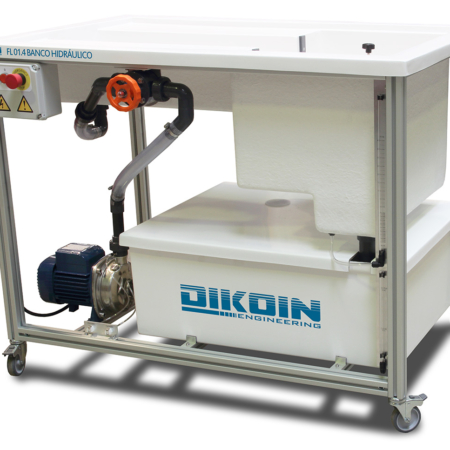
FLB 10.1 – Hydrostatic Pressure

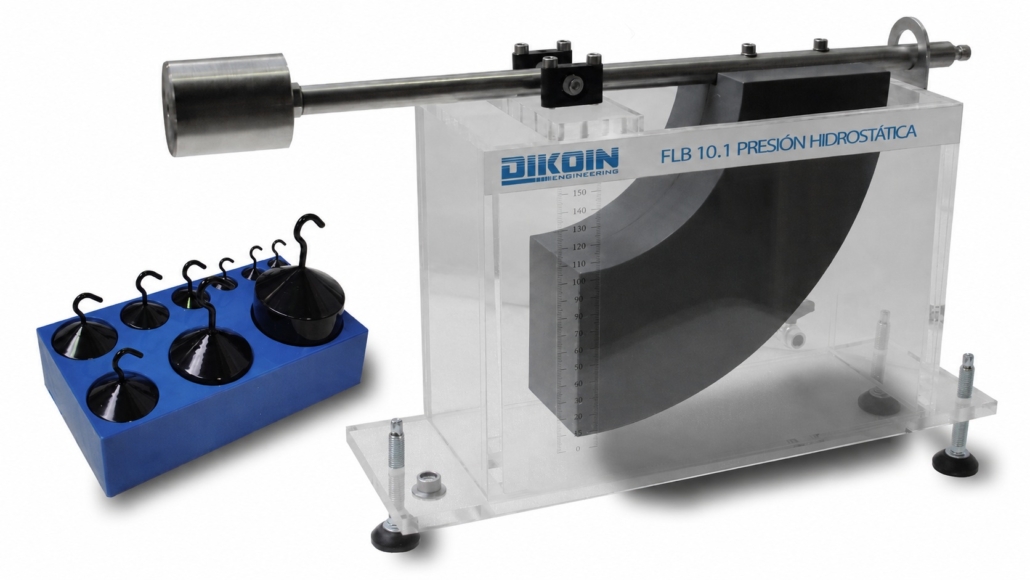
The FLB 10.1 – Hydrostatic Pressure unit is designed for the experimental study of the pressure exerted by a fluid on a submerged flat surface. It enables practical analysis of the fundamental principles of hydrostatics and moment equilibrium.
Description
The system includes a sector or quadrant that is immersed in water during the test. Its geometry is designed so that the hydrostatic forces acting on the curved surfaces do not generate a moment about the pivot axis. As a result, the force to be balanced by the weight system mainly corresponds to the force exerted on the vertical rectangular flat surface.
The water height is measured using an indicator scale, taking the lower point of the submerged rectangular face as the reference. This measurement makes it possible to directly relate the water level to the generated hydrostatic force and to the position of the centre of pressure.
The assembly formed by the quadrant and the balance arm is supported on bearings with glass balls, minimising friction on the pivot axis. This arrangement increases the sensitivity of the system and helps obtain more accurate measurements during practical exercises.
The unit allows tests to be carried out with the flat surface both fully submerged and partially submerged, facilitating comparison between theoretical and experimental values for force, centre of pressure and hydrostatic moment.

Learning Objectives
  • Experimental study of hydrostatic pressure exerted by a fluid on submerged vertical plane surfaces, using a submerged quadrant and as a function of water height:
    • Resultant hydrostatic force
    • Surface centroid
    • Center of pressure
    • Theoretical moment produced by the pressure force
    • Experimental moment generated by the counterweight system
    • Moment equilibrium under static conditions
  • Analysis of the pressure distribution on submerged plane surfaces for the following study cases:
    • Fully submerged plane surface
    • Partially submerged plane surface
Technical Data
Quadrant
  • Inner radius: 100 mm (R. Int.).
  • Outer radius: 200 mm (R. Ext.).
  • Width: 75 mm.
  • Distance between the suspended mass and the pivot point: 275 mm.
  • Height of the pivot point above the toroid: 100 mm.
  • Total depth of the submerged quadrant: 150 mm.
Counterweights
  • Set of weights: 1 x 10 g, 2 x 20 g, 1 x 50 g, 1 x 100 g, 2 x 200 g, 1 x 500 g and 1 x 1,000 g.
Construction details
  • Built-in spirit level.
  • Bearings with glass balls.
  • Height-adjustable feet using a flat-head screwdriver.
  • Water height indicator scale from the lower edge of the test surface: approximately 160 mm.
  • Tank manufactured from methacrylate.
  • Tilting arm and metal structures manufactured from stainless steel and aluminium.
Dimensions
  • Approximate equipment dimensions: 500 x 300 x 150 mm.
  • Approximate weight: 10 kg.
Requirements